25.9.14

M&E Training for recently launched projects

From 8 to 12 September 2014, the Regional Office in Hanoi organised a five-day training course on project monitoring for staff from three newly launched rural development projects in Vietnam, i.e. VIE/033 Hue, VIE/035 Tuyen Quang, and VIE/036 Cao Bang, as well as regional office staff, to instill a more explicit “results-oriented” approach in the monitoring of LuxDev projects.

Sharing his expert knowledge combined with his elegant Italian charms, Andrea Pozza, an M&E consultant, guided the 15 participants through the basics of project monitoring. Thereby putting the emphasis on clearly defined indicators, monitoring manuals, monitoring matrix and monitoring work plans (MaMaWos). Major outputs of this training are revised project log-frames as well as an improved project reporting system that includes appropriate sets of indicators and a risk management matrix.

There was active participation and interaction between the participants who shared their experiences in M&E, while at the same time applying the gained knowledge towards the development of reporting systems for their own projects. Confident with what they have learned, they will operationalize the monitoring systems in the months to come as an integral part of the implementation of their projects.

Lien Bach Ngoc | Project Officer | ROFHAN


Labels:

3.12.12

Conférence de clôture du projet VIE026 “Développement du marché des capitaux au Vietnam”

Le 26 november 2012, dans le cadre du Projet VIE026 “Développement du marché des capitaux au Vietnam” financé par le gouvernement Luxembourgeois, l'agence luxembourgeoise pour la coopération au développement (Lux-Development) a étroitement coopéré avec la Commission d'Etat des valeurs mobilières/Comité de pilotage pour organiser la conférence de clôture afin d'évaluer les résultats, les leçons tirées lors du déploiement du projet ainsi que de prévoir les aides et les coordinations à venir dans le domaine du marché des valeurs mobilières. La vice - président, directeur du comité de pilotage du projet, Madame Nguyễn Thị Liên Hoa a présidé la conférence avec la participation des représentants du Ministère du Plan et de l'Investissement, du Ministère des Finances, du Commission d'Etat des valeurs mobilières, de Lux–Development, de l'ATTF, et les consultants du projet VIE026. 

Lors de la conférence, les consultants et les représentants du bénéficiaire ont résumé les résultats significatifs du projet : l'élaboration d'un cadre légal régularisant le marché des valeurs mobilières, les voyages d'étude dans le pays et à l'étranger, l'organisation des conférences recueillant les idées des participants pour perfectionner les textes et lois, ainsi que de construire un système d'informatique en faveur des fonctions de la surveillance et de la divulgation de l'information auprès les entreprises publiques. 

Les participants ont confirmé les grands résultats du projet non seulement au niveau de la quantité mais aussi de la qualité. Les activités du projet ont contribué à insérer et les pratiques et les normes internationales dans le système de lois régularisant les marchés vietnamiens des valeurs mobilières; à partager les connaissances, le cadre légal, la réalité et les expériences internationales; à renforcer la coopération internationale entre la Commission d'Etat des valeurs mobilières et les organismes internationales. 

Flexibilité est un des points forts du projet. Dans le contexte où les marchés des valeurs mobilières sont changeants, ce n'est pas facile à gérer pour la Commission d'Etat des valeurs mobilières, ce projet a permis d'élaborer de nouvelles stratégies avec une grande capacité d'adaptation dans le but de développer le marché des capitaux au Vietnam. 

D'ailleurs, ce projet a donné l'élan à plusieurs d'activités de la Commission d'Etat, surtout avec la création du système d'informatisation des fonctions de la surveillance et de la divulgation de l'information, financé par le gouvernement Luxembourgeois. Actuellement, la Commission d'Etat est en phase de développement et de perfectionnement, la coopération concernant le cadre légal et le système d'information reste à renforcer davantage dans l'avenir. 

Les représentants de Lux–Development ont également confirmé que les grands résultats et les leçons tirées du projet ainsi que les propositions de la la Commission d'Etat serviront de base pour la formulation de nouveaux projets du gouvernement Luxembourgeois dans le domaine des banques et finances. De plus, les résultats du projet seront clairement mentionnés dans le rapport annuel du Ministère des Finances, rubrique coopération internationale, prévu pour la fin de décembre 2012.

Juste avant la conférence de clôture du projet VIE026, le 25 novembre 2012, la Commission d'Etat des valeurs mobilières, en coordination avec Lux–Development a solennellement accordé le certificat de mérite "pour le développement du marché des capitaux au Vietnam" par la vice - président de la la Commission d'Etat à Monsieur Geert De Bruycker, représentant régional de Lux–Development au Vietnam, suite à ses excellentes contributions à ce sujet. 

Labels:

31.7.09

Miss Saigon

Theme: Social Inclusion

Nguyen sells Nuoc Mia, a traditional Vietnamese drink made from fresh sugar cane, delivered daily straight from the field and crushed to order by a press attached to her street side cart. The three-wheeled cart is un-motorised; at sixty-something years of age (she's not sure exactly), and four foot nothing, Nguyen pushes the hefty stall to her regular site every morning, and then moves it about the city throughout the day as trade demands. She shouts as she walks, competing with the ever-present cacophony of motorbike horns and street traders that is Ho Chi Minh City. When she finds a customer she cranks the press by hand, and serves up the drink in a clear carrier bag, wrapped around a plastic straw with an elastic band.

Passing by the new KFC outlet, the Gucci store and the shopping mall, she pauses in the sticky midday heat; overhead, the petit silhouette of Nguyen beneath her conical straw hat is dwarfed by an oversized, neon red Coca-Cola advert. Life Tastes Good, it declares. Not for the first time in Nguyen's life, her world, Ho Chi Minh City, is changing.

The catalyst for this latest change to the city once known as Saigon, Vietnam's largest urban settlement was Doi Moi, or 'New Thought', an economic reform programme introduced in 1986 after attempts by The Communist Party of Viet Nam to create a centralised, wholly agricultural society failed, generating nationwide poverty and eventually famine.

Do Moi directed the country towards a socialist version of a free market economy and as such Ho Chi Minh City began to open its doors to foreign investors. An export market was developed, glass towers and business men in suits emerged, and many Vietnamese ditched their bicycles for motorbikes, and more recently, cars. Many became rich; some exceptionally rich. Vietnam became recognised as one of the world's newest money pots and wealthy investors swarmed to it. To the visitor, Ho Chi Minh City portrays a prosperous image of global success.

True, general living conditions in Vietnam have improved vastly since 1986, and poverty levels have dropped at a staggering and highly commendable rate. However, a 2004 report by The World Bank suggests that while the country's wealthiest citizens continue to prosper and succeed, and whilst the newly created middle class Vietnamese continue to climb The Ladder to Better Things, for the country's very poorest citizens, those who began at the very bottom of the scale, Nguyen and her contemporaries, conditions are in fact deteriorating. Over the coming years, Vietnam, it is predicted, may transcend from once being one of the most egalitarian societies in the world to becoming one of the most polarized and socially unjust.

Nguyen is one of thousands of street traders in Ho Chi Minh City. So prevalent are the traders, pushing their wares in carts, yelling from behind market stalls, peddling bicycles, riding motorbikes over-laden with goods, or carrying baskets of fresh produce hung from poles across their shoulders, that they have become icons of the city, synonymous with urban life in Vietnam.

In the state's quest to create a sleek image of global modernity, however, gradually, one by one, the street traders are finding themselves increasingly squeezed out of life in Ho Chi Minh City.

The beginnings of this movement began during 2005, when The People's Committee, Ho Chi Minh City's administrative board, declared plans to eradicate nearly half of all Ho Chi Minh City's existing market places by 2010. This was to make way, it was stated, for a more controlled, centralised food distribution network within the city; essentially paving the way for the inevitable supermarket domination of the food chain.

The displacement of street traders continued in 2008 when all three wheeled vehicles were banned from the majority of the city. This was approved in the name of traffic calming, but in effect prevented thousands of traders like Nguyen from working. Not only does this jeopardise Nguyen's income, but also creates a band of knock-on effects. Supermarket shopping suggests a certain level of wealth. It presupposes the ability to buy in bulk, transport goods and store food for a length of time. For the poorest Vietnamese, this is not a possibility. For those who tend to shop frequently in small, cheap, readily available batches, street traders provide an essential life line.

Similarly, The People's Committee have also stated at some point this year, that they intend to remove the city's distinctive street cleaners; an occupation normally held by the elderly, who push rubbish carts around the city, collecting litter and making a modest profit by trading at recycling plants. It is one of the lowest income trades in the city, and whilst the streets are kept exceptionally tidy, the rubbish collectors are an all too clear, all to visible symbol of poverty, and not in keeping with the new face of Ho Chi Minh City.

The new face of Ho Chi Minh City is a mask. The glass towers are a stage set. The state authorities are prioritising image over substance and those with the least voice to object are suffering the most as Vietnamese urban culture is swept away on a tsunami of globalization.

This problem is not unique to Vietnam, but rather Ho Chi Minh City serves as a microcosm of a world-wide phenomenon. Globalization is a two-faced event; it creates millionaires, but at the expense of millions. It creates shining utopias which vilify their inhabitants, and ultimately, what is a city, if not its inhabitants; all of them.

As the air cools in the late afternoon, the police eventually catch up with Nguyen. They fine her on the spot for illegal street trading. She pushes her cart home, all her day's taking lost. Life Tastes Good, beams the sign as she passes underneath it.

Source: http://www.guardian.co.uk/journalismcompetition

Labels:

9.12.08

Villa Hué

Villa Hue is a 12 room boutique hotel and practical training center for the youth from Hue Tourism School. The hotel is located in the center of the city giving it easy access to the beautiful Perfume River and all the cities main attractions. Guests will experience first hand service from the eager students of the school, some of who are experiencing working in a hotel environment for the first time.

www.villahue.com

Labels:

29.9.08

Powering the Mekong with rice husks

As the search for alternate sources of fuel continues in earnest, Vietnamese scientists have found great potential for a source of power in the scourge of the Cuu Long (Mekong) Delta rivers – water hyacinths and rice husks. Hoang Vu and Van Dat report.
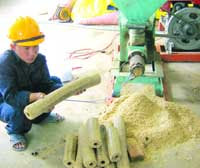

Big rod of power: Nguyen Van Vu explains the working of a rice-husk-firewood machine. — VNS Photos Le Hoang Vu
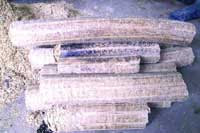

Price is right with rice fuel: Cui trau or rice husk wood is easy to burn, releases almost no smoke and causes no pollution.
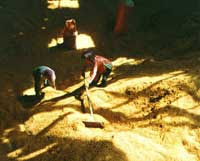

Husky: Farmers pack rice husks into bags before selling. — VNS Photo Vu Huyen


Basket-case: A farmer carries rice husk from a rice husking factory in Co Do District, Can Tho City to a boat. The husk is being turned into a fuel-rod in the delta.
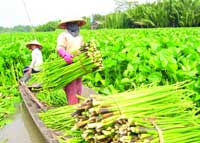

Useful weed: Water hyacinth being collected in Hau Giang Province. The weed is now used to make handicraft items and generate biogas in the southern provinces.

Flour mill owner Le Minh Truong was struggling with the dramatic increase in coal prices.

The Can Tho City entrepreneur was beginning to wonder if his business would survive when word reached him about scientists in his own neighbourhood producing a new kind of fuel – cui trau (rice husk firewood).

Truong needed no second introduction. "I knew exactly that I needed this material for my business."

Every day now, he makes his way to Hau Giang Province’s Phung Hiep District to buy five or six tonnes of cui trau at VND1,000 per kilogramme for drying flour produced in his factory.

Truong has plenty of company.

Other flour mills, pottery and brick kilns in nearby provinces and HCM City are also sold on the newly invented fuel. Most of them say it is easy to fire, releases almost no smoke and causes no pollution. Fire from the fuel lasts even longer than from coal.

The story of how a waste product from rice farming – that was a headache for rice mills, fishermen and fish breeders in the Cuu Long (Mekong) Delta – was transformed into a much-sought after fuel, begins with an unknown farmer in Tien Giang Province.

It is known that this used to be a popular source of fuel in South Korea and China before the unknown farmer reinvented the machine that made the "husk firewood".

And like the reinventor, the machine would have languished in relative obscurity were it not for engineers from Can Tho University who bought it and used biogas instead of electricity to operate it.

The waste and weed

With the world plunging from one energy crisis to another, people and governments the world over are seized by the need to source fuel by alternate means.

The Vietnamese government got into the act as well, encouraging projects to exploit biological combustibles to replace traditional firing methods in order to achieve energy security and ensure environmental protection.

Nguyen Phu Cuong, deputy head of Science and Technology department under the Ministry of Industry and Trade, says the Government approved a scheme to develop biofuels through 2025.

As a result, biogas generated from animal waste, bio-diesel produced from rice, maize, manioc and sugar cane, or ethanol from tra catfish grease were researched and began to be applied around the country.

However, rice husk and water hyacinth, the waste and the weed found every where in Mekong Delta, fell below the radar.

The delta’s waterways continued to be polluted by the illegal dumping of rice husk and clogged by the floating weed, water hyacinth.

A recent investigation found that rice mills in Hau Giang Province annually release 220,000 tonnes of husk into the water. While farmers in rural areas have known how to use rice husk to cook their meals, they had been discouraged by the time, effort and money needed to carry and store it.

Nguyen Van Don, owner of a rice mill in Dong Thap Province says that before 2004, when ceramic, brick making business used rice husk for firing their kilns, farmers also used it to cook their meals.

Then he did not have to release the husk into the rivers, and was actually able to sell the waste to traders at VND350 a kilogramme. In one season, he could earn VND150 million ($9,375) from the sales.

With the rising popularity of coal, gas and other advanced fuels, rice husk fell out of favour, and he had no choice but to dump them in the water despite knowing that it was illegal, because he had no space to store it.

In An Giang Province, where there are around 1,000 rice mills, the situation is similar. One mill owner, Tran Thanh Hon, recalls that in the past, rice husk traders had to plead to get the waste at VND70,000 ($4.4) per tonne, but now, factory owners cannot find takers even though they are willing to pay people to move it out.

Fish breeders are among the victims of this dumping practice, claiming that the resultant water pollution is killing their fish.

For several years, water hyacinth on Mekong Delta waterways was used to feed livestock or poultry, or making handicraft items, but there was still too much of the floating weed.

Now, with this rediscovery, rice husk and water hyacinth are enjoying a renaissance.

Timely innovation

Nguyen Huu Phong, an engineer from the Hoa An Biological Research Centre under Can Tho University, is one of the team of scientists behind the new machine that makes cui trau from rice husk and water hyacinth.

The machine, costing VND15 million ($937), uses a three horse-power engine to make 80 kilogrammes of the new firewood an hour. Around 105 kilogrammes of rice husk will yield one kilogramme of firewood.

The cylindrical firewood pieces are about 73mm in diameter and 0.5 to one metre long each. One kilogramme of this firewood can be used to cook meals for four people for a whole day. The product is being sold to farmers at VND1,000 per kilogramme. Many people say the price is too expensive for farmers.

But Phong says heat from the new fuel will last longer than that of coal, adding that since the factory opened, many people from central provinces, Tay Nguyen (Central Highlands) and HCM City are buying the firewood daily.

Most businesses that used to burn coal to heat their boilers now use cui trau thanks to its reasonable price and higher capacity, not to mention it causes less pollution.

Phong says the centre is not able to meet the demand of enterprises. Many business owners from HCM City consume between seven and eight tonnes a day.

Phong says the plan is to make the prices even lower and increase capacity by transferring the technology to every household in the delta and encourage rice mills to put to good use their waste. Most importantly, the new fuel will help many families save money and reduce the negative impacts of using coal.

Local authorities estimate that the Mekong Delta annually produces some 3.6 million tonnes of rice husk. The need is obvious, therefore, for more machines to process it and present residents and businesses with a cheaper, more environmentally friendly fuel. — VNS

(21-09-2008)

Copyright by Viet Nam News, Vietnam News Agency

website : http://vietnamnews.vnanet.vn

Labels:

5.9.08

Profitable waste

An environmental project in the Mekong Delta is set to make things a little easier for farmers – and the environment.


Nguyen Van Vu, who is in charge of Hoa An Center’s electricity,
displays the husk firewood produced by the pressing machine.


Rice husks and water hyacinths have long been considered waste material in the Mekong Delta.

However, opinions of these products are changing after a joint project (Project VIE/020) with the Luxembourg government was launched to recycle agricultural waste and put water hyacinths to work to help the local economy.

Water hyacinth (Eichhornia Crassipes) causes headaches for local farmers by impeding river transport, decreasing local biodiversity and carrying germs.


Water hyacinths. A project in the MekongDelta
is looking for ways to make use of thecommon water weed pest.


“The water hyacinth can cause disaster if we do not know how to use it, but if we know what to do we can find beneficial uses for it,” said Dr. Do Ngoc Quynh, technical consultant to Project VIE/020.


Project researchers have managed to use hyacinths and other agricultural waste in the production of breeding fish, mushrooms and fish food, said Pham Hong Thai, director of the project management board, at the opening ceremony of the Hoa An Center for Research – Application – Biodiversity.

The center, based in the Mekong Delta’s An Giang Province, is devoted to the project.


Hyacinth extract can help increase the pH (the measure of acidity or alkalinity) of water from 3.2 to 4.5, creating an ideal environment for chlorella algae, the food of some native fish species.

Researchers have also made fertilizers and bio-gas from water hyacinth for local families, Thai said.

About 2,340 farmers in Hau Giang Province have a monthly income of less than VND300,000 (US$18.33) and no land.

They are expected to receive training on how to use agricultural waste like rice husks and hyacinths to improve their income, Quynh said.


The center’s experts will train 450 farmers in the method of processing hyacinths and bio-gas, Quynh said.


A further 1,800 people will be trained in seafood and agriculture farming methods.

“Once it is successful, the project will make a considerable contribution to the transformation of problematic hyacinths into something socio-economically effective in Hau Giang Province in particular and the Mekong Delta in general,” Thai said.


Another source of fuel

The center also introduced husk firewood made from rice husks by a VND15 million ($916.65) pressing machine bought from the southern Tien Giang Province.


The presser is able to produce 70 to 80 kilograms of firewood per hour and consumes around 6 to 7 kilowatts an hour.


Every 1.05 kilograms of husks produces one kilogram of firewood, which is sufficient for cooking a meal for four.


Husk firewood has the diameter of 73 millimeters and the length of 21 centimeters.

Hoa An Center for Research, Application and Biodiversity engineer Phong said husk firewood burnt at a slower pace than husks or charcoal and could be used to cook any kind of food.


It is even suitable for grilling, he said.


Tran Thanh Chac, who lives in the Hoa An Commune, said husk firewood was easy to use.


The most important factor is that the firewood is completely burnt, leaving no waste.

It also has a sweet fragrance.

Other families nearby the center have also given positive feedback about the husk firewood.

However, after the trial period, they have yet to buy the firewood, since their own firewood is easily accessed in the garden.

The price of VND1,000 ($0.06) per kilogram, meanwhile, is not good, according to Truong, who lives in Can Tho City and buys around five to six tons of husk firewood per day for his business.


Phong, meanwhile, says this is just a trial price, adding that the center will transfer the technology to those families who have the need to use it.


The important thing was to encourage rice milling factories to buy the machine to make firewood from rice husks, he said.


It will help tackle the overwhelming amount of rice husks and bring benefits to them.

The three-year-project was started in 2006 with €5 million (US$7.4million) in sponsorship from the Luxembourg Agency for Development Cooperation to help local farmers improve their incomes.


Source: TBKTSG, SGTT

Reported by Phu Sa Loc - Gia Khiem

Story from Thanh Nien News

Published: 28 August, 2008, 11:18:10 (GMT+7)

Labels:

20.8.08

In Vietnam, even ghosts feel inflation's pinch

A vendor offering goods in Hanoi. August is when Vietnamese Buddhists traditionally provide offerings to the deceased, but many ghosts have gone hungry this year. (Justin Mott for The New York Times)

HANOI: Even the ghosts are suffering from inflation in Vietnam this year.
August is the month when Buddhists provide the hungry ghosts of the dead with food and wine and cigarettes and paper offerings that represent the good things in life - cars, houses, motorbikes, stereo sets, fancy suits of clothes.

But like everything else in Vietnam, these brightly colored offerings have risen steeply in price and shopkeepers say people are buying fewer gifts to burn for the dead than ever before.


With inflation rising to 27 percent last month - the highest in Asia - and food prices rising to 74 percent above those a year earlier, Vietnam is suffering its first serious downturn since it moved from a command economy to an open market nearly two decades ago.


Last month, the government raised the price of gasoline by 31 percent to an all-time high of 19,000 dong, or $1.19, a liter, or $4.50 a gallon. Diesel and kerosene prices rose even more. The country's fledgling stock market, which had been booming a year ago, has fallen in volume by 95 percent and is at a virtual standstill.

Squeezed on all sides, people are cutting back on food, limiting travel, looking for second jobs, delaying major purchases and waiting for the cost of a wedding to go down before getting married.


Some village women who traveled to Hanoi to sell special homemade candies for the hungry ghost festival say they have not earned enough this year to return home.


Given this slowdown, Asia's youngest tiger, which had been growing by about 8 percent a year for the past decade, is scaling back its plans for economic development.


Last month, the Asian Development Bank forecast that growth would slow to 6.5 percent this year. Some economists say even that figure is probably too high.

The mood in Vietnam, after years of upward mobility, is tense, said Kim Ninh, country representative of The Asia Foundation.


"I think people are pessimistic," she said. "You sense a tougher environment, a more restricted environment, a more pessimistic environment. It's a moment of turmoil, I think."


People are losing confidence in the ability of the government to manage the economy, several people said. Rumors of price rises have caused panic buying of fuel and rice.

"The government seems confused how to deal with the difficulties and they have been making some mistakes in running the economy," said a young lawyer, who spoke on condition of anonymity when criticizing the government.

Hundreds of strikes at the factories that have been an engine of Vietnamese growth are one of the sharpest signs of discontent.
Some of the factory workers who are leading Vietnam's emergence from poverty are returning to the countryside, according to the local press, unable to sustain an urban life on a factory wage.

"Some people who have been moving from rural areas to seek jobs in industrial zones are deciding that it is not worth it, and people are moving home," said Ben Wilkinson, associate director of the Vietnam Program of the John F. Kennedy School of Government at Harvard.


After a steep reduction in the poverty rate from 58 percent of the population in 1993 to around 15 percent last year, some people - those who have bought their first motorbike or mobile telephone - are slipping back again below the poverty line.

Prime Minister Nguyen Tan Dung told the National Assembly in May that the number of households going hungry had doubled in one year.


Everywhere they turn these days, people in Vietnam see higher prices.


A shoeshine has gone from 19 cents to 25 cents; a good haircut from $1.25 to $1.87; a tiny cup of tea on the street from 3 cents to 6 cents; a one-time-use rain coat from 12 cents to 37 cents, a massage from $4.37 to $6.25. It now costs 12 cents to park your motorbike on the sidewalk, and if you get a flat tire, it costs 12 cents to get it pumped, double the prices of a few months ago.


The costs of housing and construction materials have risen by 24 percent, driving up the price of real estate and rents. High fuel prices have led some fishermen to keep their boats onshore, and the government has stepped in to subsidize them.


As the local currency, the dong, drops in value, people say they are moving their money into dollar-based bank accounts.

Nguyen Minh Phong, an analyst of inflation with the Institute of Socioeconomic Development Research who dabbles in real estate, said his personal woe was that he had 13 brothers and sisters who missed the real estate bubble and now come to him for loans.


In part, economists say, Vietnam is suffering from the worldwide economic downturn and from high inflation that has spread through Southeast Asia.

But they say the problems are also self-inflicted, the result of an overheated economy as Vietnam raced forward with inadequate safeguards.


Too much capital, particularly from foreign investment, has collided with bottlenecks in infrastructure and capacity.


The education system is producing too few skilled and semiskilled workers for Vietnam to move up quickly into more complex manufacturing industries.


In the longer term, most economists agree, Vietnam will continue the transformation it began in the early 1990s with a new policy of economic restructuring called "doi moi" that was decreed in 1986.


Private enterprise was sanctioned and then encouraged, agriculture was freed from government controls, hyperinflation was tamed and Vietnam became, like China, a largely capitalist nation under the control of a Communist government.


Foreign investment boomed as new regulations and tax laws were introduced, business law was formulated and capital market reforms were put in place. The changes were consolidated with accession to the World Trade Organization in 2006.


Vietnamese leaders, with their ambitious targets for growth, are in a hurry to surpass their neighbors and to become, as they put it, a modern and prosperous nation.


With a growing population of more than 80 million - three-fourths of whom are under the age of 35 - this is a nation looking into the future, with ever dimmer memories of its wartime past.


Throughout the years of strict Communist rule, when religion was banned, the ghosts of the ancestors languished, uncared-for and unappeased.


Religion returned to Vietnam along with free commerce and the festival of the hungry ghosts was revived. The two have flourished in tandem, and now both are feeling the pinch of inflation.


"It's terrible right now," said Dinh Vu Hung, 54, who sells paper offerings in the Ancient Quarter of Hanoi. "We make these beautiful things, but the prices have gone up and fewer people are buying them. It's not just us, though. It's the whole country."


Published: August 19, 2008 - By Seth Mydans. International Herald Tribune

Labels:

11.9.07

Un projet au fil de l'eau...

« Un projet avec des jacinthes d’eau » ! Maintenant encore, quand j’énonce l’intitulé du projet, les mots font sourire. Et pourtant ! Cette plante flottante qui prolifère dans le Delta du Mékong et qui est parfois envahissante au point de bloquer les bateaux dans petits arroyos, se retrouve bel et bien au cœur d’un de nos projets. Jadis, cette plante servait à nourrir les porcs et à en faire de l’engrais bon marché. Aujourd’hui, grâce au savoir-faire des vanniers, les tiges séchées se transforment en vases, paniers, corbeilles, sets de table, qui sont envoyés aux quatre coins du monde et qui finissent au rayon décoration chez Ikea….


Fig. 1 : artisanat fait à partir de jacinthes d'eau

L’usage de la jacinthe d’eau ne s’arrête pas là, et c’est bien ce que le projet vise à démontrer. Mélangée à d’autres matières organiques, la jacinthe d’eau peut rentrer dans le processus de production de biogaz, de compost, d’ensilage pour bétails ou même encore de champignons. Redonner en quelques sortes une seconde vie à ce végétal et apprendre à utiliser les résidus organiques pour améliorer l’aquaculture et l’agriculture notamment ou bien encore pour obtenir du gaz pour cuisiner. Il s’agit surtout de permettre aux fermiers de la Province de Hau Giang, située dans le delta du Mékong, de reproduire les techniques apprises lors des séances de formation. Et augmenter leurs revenus… Voila donc, en quelques mots, les objectifs de ce projet.

Mais avant, il faudra de nombreuses expériences en laboratoires universitaires, à petite échelle, de nombreuses analyses chimiques, de nombreuses heures de discussions, et de discussions encore … Et puis, petit à petit, apparaîtront les premiers résultats: on achète des équipements, on construit des étangs à poissons, on inaugure un biogaz digesteur, on programme des séances de formation….


Fig. 2 : jacinthes d'eau

Et à moi il me faudra une fameuse dose de patience. Apprendre qu’un projet a parfois le rythme d’un sampan chargé de riz et qui navigue lentement sur les eaux du Mékong…

J’apprendrai à poser les bonnes questions, car, d’expérience, je sais maintenant que les réponses ne viennent jamais seules, d’elles mêmes. J’apprendrai la bureaucratie et les insoupçonnables démarches qui mènent à l’obtention d’un numéro de TVA. J’apprendrai que Moina et Daphnina sont bien les noms de minuscules crustacés et qu’un biogaz digesteur peut produire 60% de méthane et 25% de CO2…

A un niveau plus personnel, j’apprendrai le trafic à toute heure du jour et de la nuit. Avec le temps, je saurai même m’y insérer avec mon vélo. J’essayerai d’apprendre une langue qui s’apparente toujours autant à du chinois pour moi… J’aprendrai à travailler dans une équipe dans laquelle se mêlent parfois conflits de génération et différences culturelles. J’apprendrai aussi des professeurs de sciences à l’université mais je pense que j’en apprendrai encore d’avantage du sourire d’un fermier. Et puis aussi de cette culture vietnamienne, si riche…

A ceux qui se demandent comment je la vis, je répondrai que mon expérience à Can Tho est aussi variée que le sont les fruits que l’on trouve dans le delta du Mékong dont les noms étranges résonnent comme durion, longane, mangoustan, sapotille, fruits du dragon, pomme à lait et dont les formes et les couleurs sont d’une incroyable diversité…


Témoignage de Catherine Mertz, Can Tho, Vietnam

Labels: